
Brendan Burke, Research Director at Futurum, explores how declining launch costs and rising terrestrial power bottlenecks could make orbital data centers a $1 trillion market by 2030.
Futurum's Brendan Burke,
Cite this
Brendan Burke, The Futurum Group, "Orbital Computing Can Reach $1 Trillion Addressable Market by 2030," April 22, 2026. https://preview.erikbethke.com/press-release/orbital-computing-can-reach-1-trillion-addressable-market-by-2030/
Analyst(s): Brendan Burke
Publication Date: April 22, 2026
SpaceX’s Starship is on track to collapse launch costs below $100/kg by decade’s end, transforming orbital data centers from science fiction into a funded industrial race. With terrestrial AI infrastructure facing multi-year grid interconnection delays and rising off-grid construction costs, Futurum estimates that approximately $1 trillion of the $3 trillion bull case in 2030 AI compute capex represents workloads where orbital deployment is economically justified.
Key Points:
- SpaceX Starship is projected to push launch costs below $100/kg by 2030 through full reuse and high flight cadence, collapsing the single largest cost input for orbital infrastructure, though launch capacity will remain supply-constrained.
- Orbital data centers will achieve cost parity first against off-grid terrestrial deployments as grid-connected facilities benefiting from existing electrical infrastructure will remain lower-cost for the majority of workloads.
- Of an estimated $3 trillion in AI compute capex by 2030, roughly one-third – approximately $1 trillion – represents workloads where orbital deployment is economically justified, including capacity facing multi-year grid queues and sovereign compute mandates in power-constrained geographies.
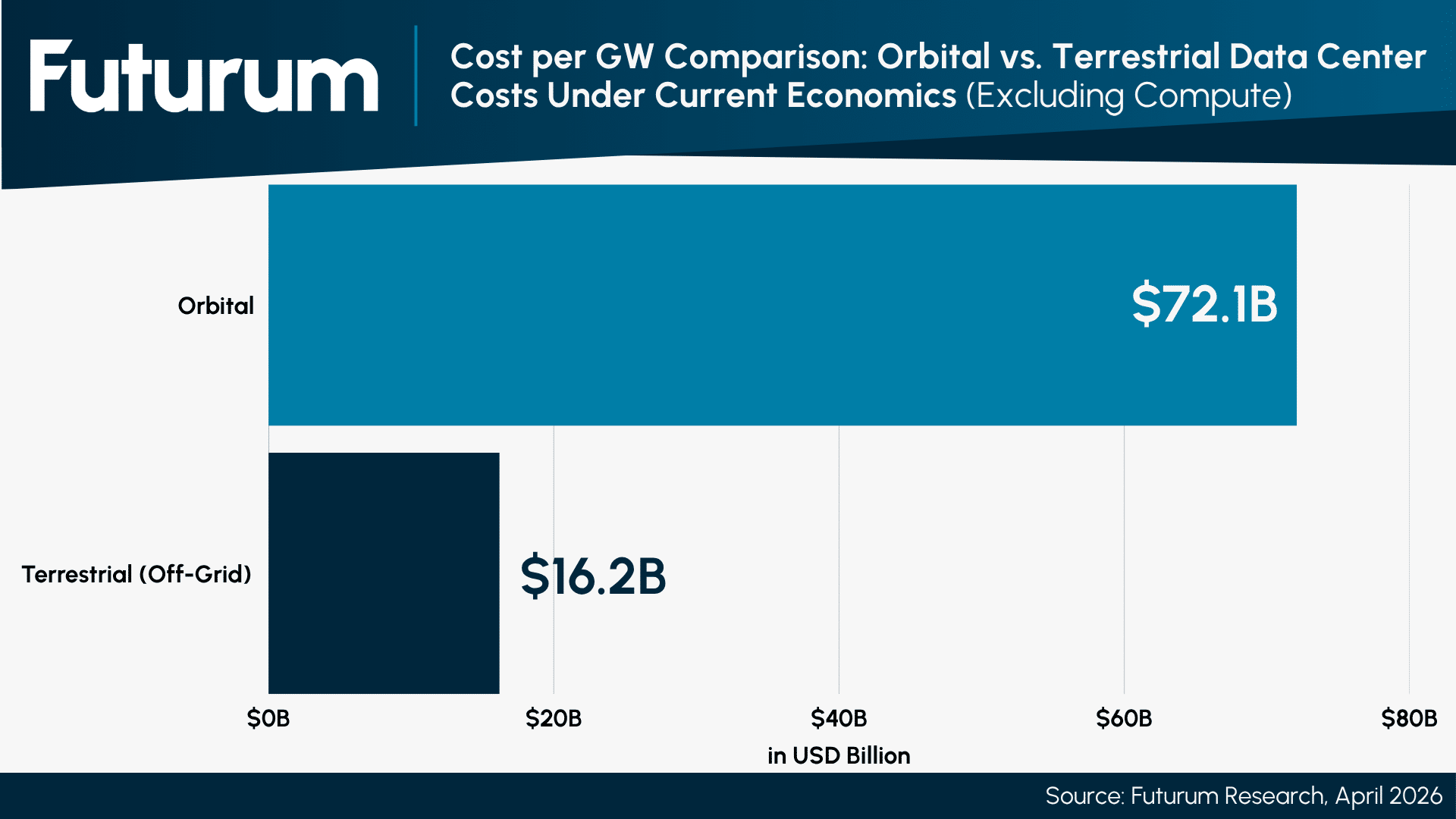
Figure 1. Cost per GW Comparison: Orbital vs. Terrestrial Data Center Costs Under Current Economics (Excluding Compute)
The Space Case for Extraterrestrial Computing
Orbital computing is rapidly transitioning from a theoretical concept to an investable infrastructure category. The core thesis rests on the convergence of rising terrestrial off-grid data center costs and declining space launch and satellite manufacturing costs. While hyperscale data centers can be constructed in 12–18 months, acquiring grid-connected power generation often takes three to seven years, stranding billions in finished but unpowered silicon. To meet AI workload demand that may require 300 GW of compute by 2030, operators are pursuing two capital-intensive strategies: terrestrial off-grid AI factories paired with dedicated power generation, and orbital data centers promising limitless solar power and infinite cooling in space.
Currently, space data center infrastructure costs carry a 4.5x premium over terrestrial, making the economics challenging. Solar panel efficiency and launch costs are the greatest sensitivities to space economics, with launch costs looking out to a clear runway for declines, with less certain gains in power generation efficiency.
However, terrestrial off-grid costs are rising while orbital costs are declining. Starcloud projects space infrastructure dropping to $5 billion per GW, a 14x decline, contingent on Starship achieving ~$500/kg commercial launch costs by 2028–2029. We expect that further launch cost declines and increased solar efficiency will be needed to hit that threshold. The crossover point arrives first for off-grid deployments where grid bottlenecks, permitting delays, and environmental costs make terrestrial alternatives increasingly expensive.
Expanding Orbital Ecosystem
The need for innovation across the value chain will create broad opportunities for suppliers. Radiation-hardened semiconductors will be a first-order concern. NVIDIA announced the Space-1 Vera Rubin Module at GTC 2026, delivering up to 25x more AI compute for space-based inferencing than the H100. AMD’s Versal AI Edge Gen 2 adaptive SoCs provide space-grade processing for orbital deployments. Optical interconnect players – including Kepler Communications, Mynaric, and Skyloom – are building the inter-satellite networking fabric. Vertical integrators span from SpaceX and Rocket Lab on the launch side to Amazon on the cloud integration side.
Recommendations
Vendors should define their addressable market with precision against the off-grid buildout pipeline, communicate orbital strategy now to position for ecosystem formation, and invest in space-hardened compute and optical interconnect that offers dual-use R&D leverage for terrestrial edge deployments. The critical variables to watch include Starship commercial cadence, radiator mass-to-power improvements, grid interconnection policy reform, and SpaceX’s vertical integration ambitions following its xAI acquisition.
Click here to access the report from our website. The full report, “Orbital Computing Can Reach $1 Trillion Addressable Market by 2030,” is also available via subscription to Futurum Intelligence’s Semiconductors, Supply Chain, & Emerging Technology IQ service—click here for inquiry and access.
About the Futurum Semiconductors, Supply Chain, & Emerging Technology Practice
The Futurum Semiconductors, Supply Chain, & Emerging Technology Practice provides actionable, objective insights for market leaders and their teams so they can respond to emerging opportunities and innovate. Public access to our coverage can be seen here. Follow news and updates from the Futurum Practice on LinkedIn and X. Visit the Futurum Newsroom for more information and insights.
Published by Futurum.
More from Brendan Burke
Rapidus’ IIM-1 Fab Construction is Completed. Will Cadence Make It the First Agentic Foundry?
Rapidus’ IIM-1 fab completes construction in Chitose, leveraging Cadence Innostack AI Super Agent for its Raads platform and IBM 2nm transistor IP to compete with TSMC, Intel, and Samsung in inference accelerator production.
SiFive BigSky Ships the First RISC-V Server. Is the GPU Head Node the Prize?
Brendan Burke, Research Director at Futurum, shares his insights on SiFive’s BigSky, the first enterprise-grade RISC-V server, and why CUDA head node duty for NVIDIA GPUs is the socket that matters.
QumulusAI Q2 FY 2026: 118% Revenue Growth for Hyperspeed AI Compute Deployment
Brendan Burke, Research Director at Futurum, analyzes QumulusAI’s Q2 FY 2026 earnings, focusing on direct AI compute demand, GPU fleet expansion, and capacity execution.