Software Lifecycle Engineering Market to Reach $226 Billion by 2030 as Enterprise Hands AI the Keyboard Before the Guardrails

Futurum’s 2H 2026 Software Lifecycle Engineering research sizes the market at $226 billion by 2030 and finds AI now runs the majority of the software lifecycle, while 75% of organizations report AI-contributed production incidents.
Futurum's Mitch Ashley,
Cite this
Mitch Ashley, The Futurum Group, "Software Lifecycle Engineering Market to Reach $226 Billion by 2030 as Enterprise Hands AI the Keyboard Before the Guardrails," July 13, 2026. https://preview.erikbethke.com/press-release/software-lifecycle-engineering-market-to-reach-226-billion-by-2030/

Austin, Texas, USA, July 13, 2026
Futurum releases its 2H 2026 Software Lifecycle Engineering Market Sizing & Five-Year Forecast alongside a global survey of 839 IT decision-makers.
The Futurum Group today published its 2H 2026 Software Lifecycle Engineering (SLE) research, pairing a five-year market forecast with a global survey of 839 enterprise IT decision-makers. Futurum sizes the SLE market at $111.1 billion in 2025, growing to $226.0 billion by 2030 (see Figure 1), a 15.3% compound annual growth rate, as artificial intelligence moves from developer assistant to running the majority of the software lifecycle. The companion Decision Maker survey finds adoption has outpaced governance: 75% of organizations have already experienced a production incident in which AI-generated code, AI agents, or AI tooling was a contributing factor.
Figure 1: SLE Market Nearly Doubles to $226B by 2030
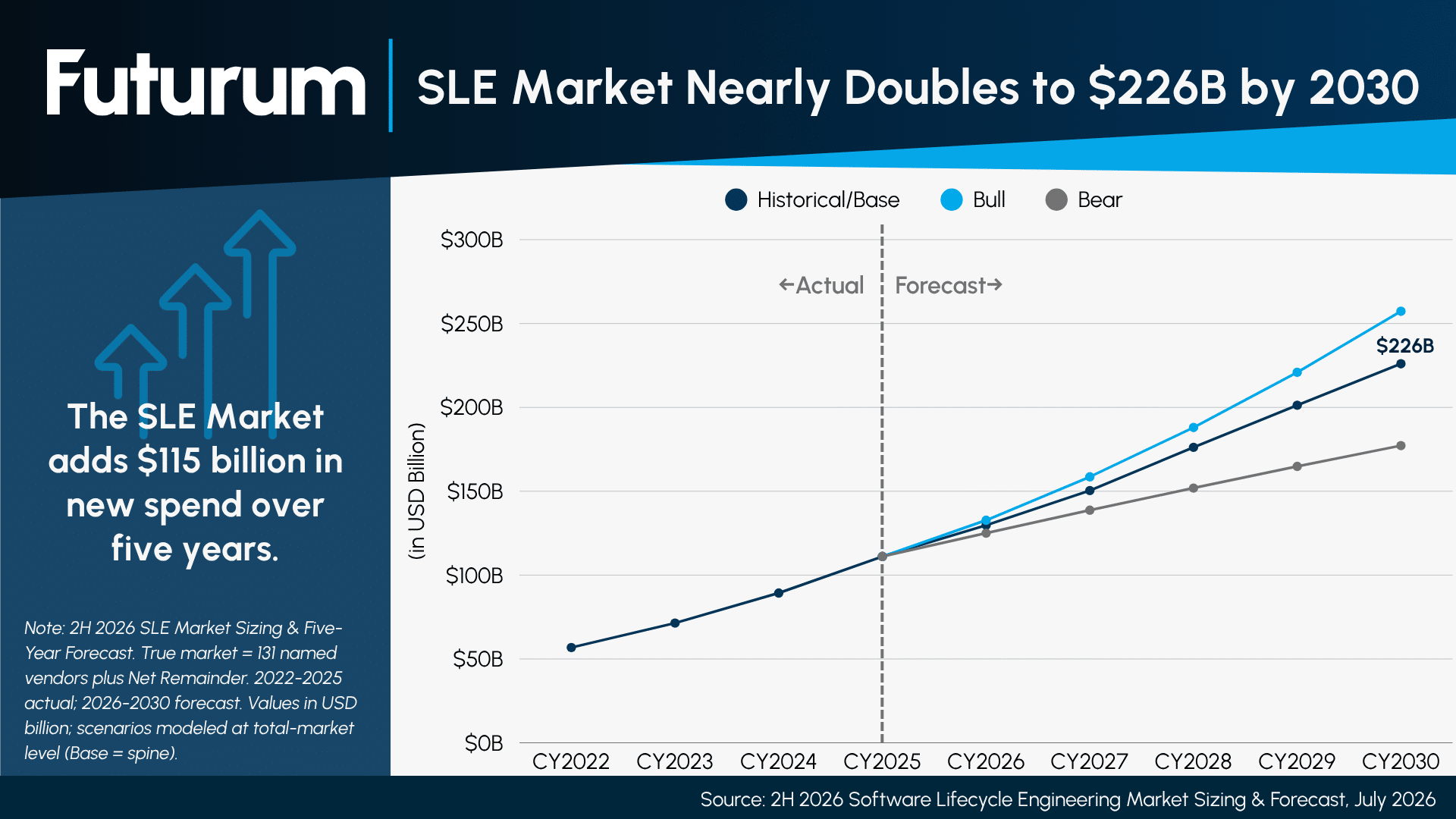
Mitch Ashley, Vice President and Practice Lead for Software Lifecycle Engineering at The Futurum Group, said, “The market is pricing in AI’s takeover of code generation and underpricing the bill for governing it. 54% of organizations already run AI across most of their lifecycle, and 40% say AI writes the majority of the code they merge to production, yet fewer than one in five have mature agent governance. That gap is the story of this forecast. The $115 billion in new spend arriving by 2030 flows fastest to the control plane for AI agents, because the constraint stopped being how much code you can produce and became whether you can trust what produced it.”
The 2H 2026 SLE research surfaces several structural shifts reshaping enterprise software development:
- The market is repricing around AI. Software Lifecycle Engineering reaches $226.0 billion by 2030, adding roughly $115 billion in new spend in five years. AI-native segments lead growth, with Agent Control Plane and Agentic Development compounding at 48.7% and 45.1%, respectively, through 2030.
- AI now runs the majority of the lifecycle. 54% of organizations use AI across more than half of their software development lifecycle, and 40% say AI already generates the majority of production code merged in the last 90 days.
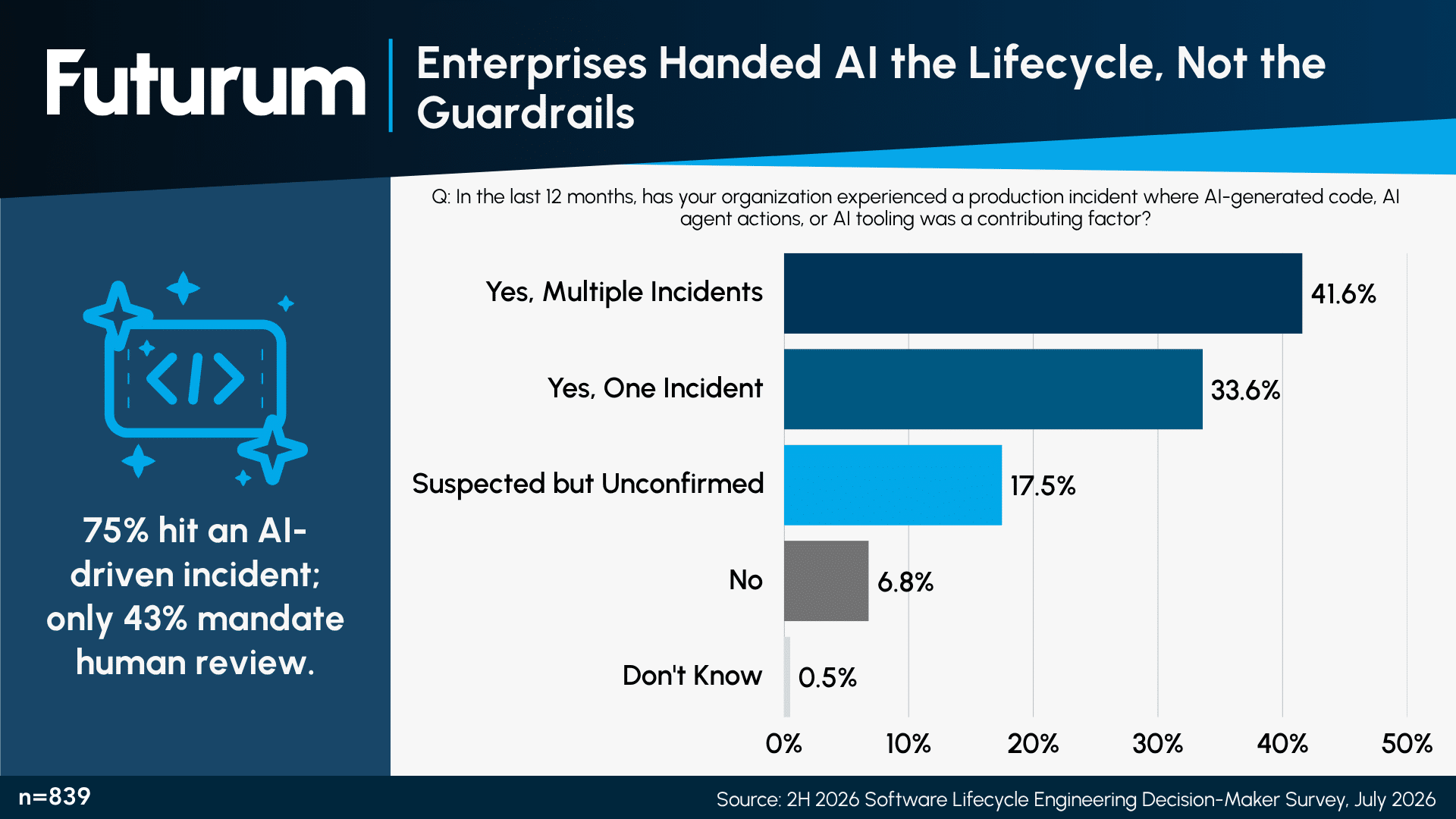
- Governance has not kept pace. 75% of organizations have had an AI-contributed production incident (see Figure 2), yet agent governance is the least-mature engineering practice, with just 18% standardized or mastered, and fewer than half (43%) mandate human review of AI-generated code.
Figure 2: Enterprises Handed AI the Lifecycle, Not the Guardrails
Subscribers can read more in the full reports, “2H 2026 Software Lifecycle Engineering Market Sizing & Five-Year Forecast” and “2H 2026 Software Lifecycle Engineering Global Enterprise Decision Maker Survey Report,” on the Futurum Intelligence Platform. Non-subscribers click here for more information.
About Futurum Intelligence for Market Leaders
Futurum Intelligence’s Software Lifecycle Engineering IQ service provides actionable insight from analysts, reports, and interactive visualization datasets, helping leaders drive their organizations through transformation and business growth. Subscribers can log into the platform at https://app.futurumgroup.com/, and non-subscribers can find additional information at Futurum Intelligence.
Follow news and updates from Futurum on X and LinkedIn using #Futurum. Visit the Futurum Newsroom for more information and insights.
Other Insights from Futurum:
Claude Fable 5 Is Most Consequential Where Software Is Built
Microsoft Build 2026 – The Platform, Integration Plane, and Developer Surface
IBM and Red Hat Bet $5B on Curating the Open Source Supply Chain
Published by Futurum.
More from Mitch Ashley
Okta Q2 FY 2027 Earnings Beat and Raise on Core Identity Strength
Mitch Ashley, VP and Practice Lead, CIO & Technology Buyers at The Futurum Group, reviews Okta’s Q2 FY 2027 earnings, where core identity strength and new products drove a beat and raise while agentic identity stayed an early, forward-looking driver.
AI Implementation Is the New Account Control Point
Mitch Ashley, VP & Practice Lead at Futurum, shares insights on how AI implementation is the new account control point. Read more on how hyperscalers are reorganizing to capture distributed AI buying authority in 2026.
A Loud Floor and a Quiet Gap: Security Summer Camp 2026
Fernando Montenegro and Mitch Ashley of Futurum unpack Black Hat and DEF CON 2026: an agentic-AI wave on every booth, a record funding surge, a widening capability gap, and what a board will actually fund.