Semantic Layer Set to Become the Next Piece of Critical Infrastructure
Austin, Texas, USA

Brad Shimmin, VP and Practice Lead at Futurum, details why the Semantic Layer is projected to double its growth to 30% by 2031, becoming the critical “dictionary” that prevents Agentic AI from hallucinating business metrics.
Futurum's Brad Shimmin,
Cite this
Brad Shimmin, The Futurum Group, "Semantic Layer Set to Become the Next Piece of Critical Infrastructure," February 25, 2026. https://preview.erikbethke.com/press-release/semantic-layer-set-to-become-the-next-piece-of-critical-infrastructure/

Austin, Texas, USA, February 25, 2026
Futurum Releases 2025-2031 Data Intelligence Forecast; Semantic Layer Identified as the Fastest Accelerating Segment, Critical for Agentic AI
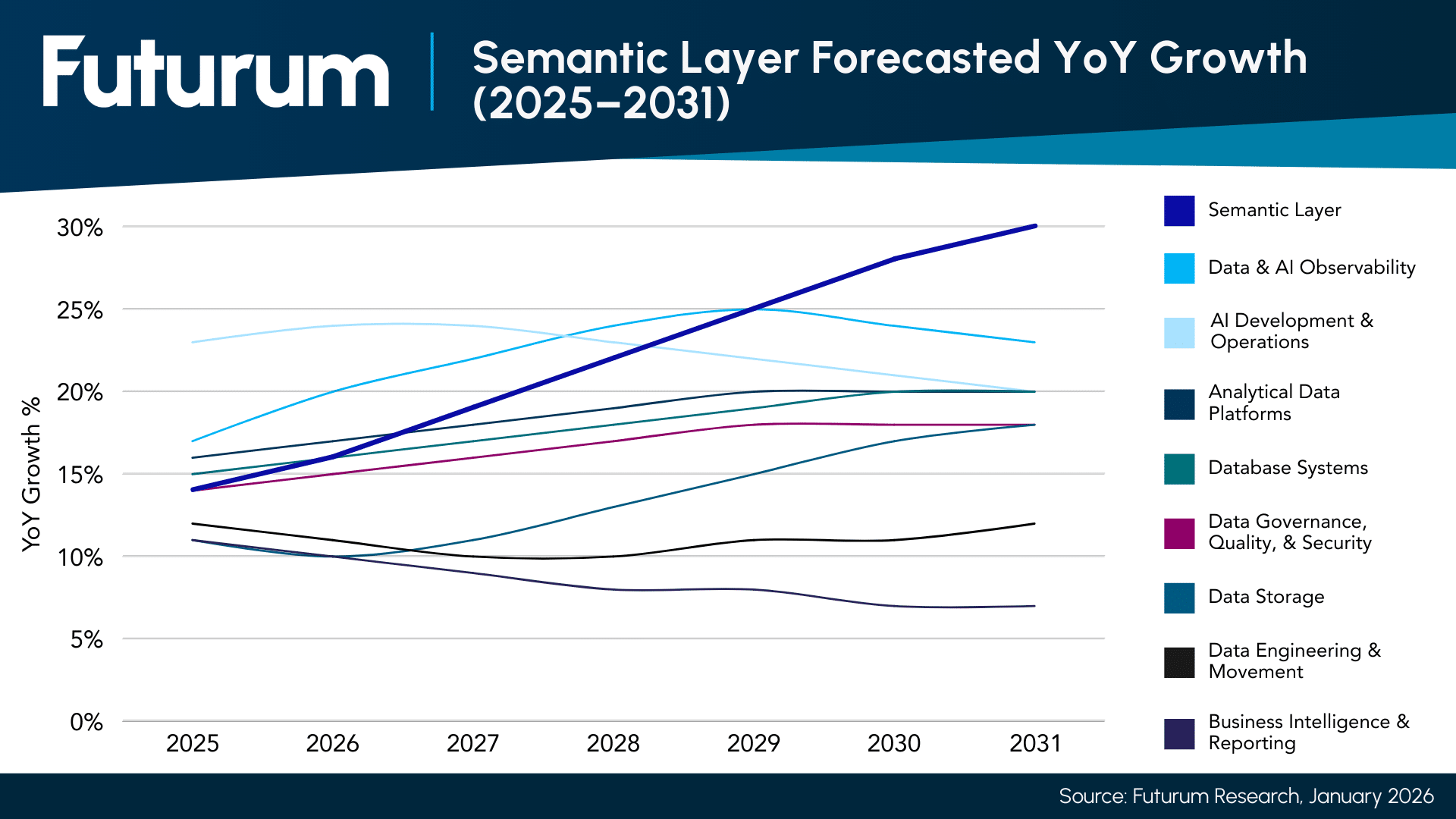
As enterprises move from experimental AI chatbots to autonomous agents, the Semantic Layer is projected to undergo a “rocket ship” growth trajectory, doubling its growth rate from 16.0% in 2026 to 30.0% by 2031, according to new market sizing data from The Futurum Group. While foundational segments like Data Storage and Data Engineering show steady, mature growth, the Semantic Layer—the technology that defines business metrics and data ontologies—is breaking away from the pack (see Figure 1). The forecast indicates that organizations are increasingly recognizing that Large Language Models (LLMs) cannot operate reliably in a business context without a unified “dictionary” to ground them.
Figure 1: Semantic Layer Forecasted YoY Growth (2025–2031)
Brad Shimmin, VP & Practice Lead for Data Intelligence, Analytics, and Infrastructure at Futurum, said, “We are witnessing a fundamental re-invention of the Semantic Layer. Historically viewed as a ‘nice-to-have’ helper for Business Intelligence dashboards, it is graduating to critical infrastructure status. If you want an AI agent to execute a trade or adjust pricing autonomously, it must understand exactly what ‘Gross Margin’ means. Without a semantic layer, you don’t have agents; you have hallucination engines.”
The data highlights a distinct divergence in the market:
- The “Rocket Ship” Effect: The Semantic Layer is the only segment in the forecast to accelerate its growth rate each year for seven consecutive years, driven by the desperation to fix AI reliability issues.
- Decoupling from BI: While “Business Intelligence & Reporting” growth slows to 7.0% by 2030, the underlying logic is migrating to the Semantic Layer. The value is moving from the *visual* dashboard to the *logical* metric store.
- Infrastructure for Autonomy: The acceleration correlates directly with the expected maturity of Agentic AI. As agents move into production (2027-2029), the demand for governable, metric-centric data access explodes.
This shift is more than just a narrative change. It is visible in the structural rotation of capital. Our 2025–2031 forecast reveals a structural rotation of capital away from legacy plumbing (Data Integration growing ~10–12%) toward intelligence infrastructure (Semantic Layer and Observability growing >20%).
“The rapid rise of the Semantic Layer illustrates just how critical AI has become for data professionals. Our data shows that the ‘Data Technician’ era is rapidly evolving into the ‘AI Shepherd’ era,” noted Shimmin. “Companies are realizing they can’t just dump raw data into a vector database and hope for the best. To optimize for success, IT leaders need to shift budget from Day 1 ingestion tasks to Day 2 semantic governance. If your data doesn’t have a reliable and repeatable meaning attached to it, your AI is flying blind.”
The forecast suggests that by 2031, the Semantic Layer will likely be the fastest-growing sub-segment in the entire Data Intelligence stack, expanding at an average of 22-24% annually and surpassing even “Data & AI Observability” as the primary control plane for the AI-driven enterprise.
Read more in the report “1H 2026 Data Intelligence, Analytics, & Infrastructure Market Sizing & Five-Year Forecast Report” on the Futurum Intelligence Platform.
About Futurum Intelligence for Market Leaders
Futurum Intelligence’s Data Intelligence, Analytics, and Infrastructure IQ service provides actionable insight from analysts, reports, and interactive visualization datasets, helping leaders drive their organizations through transformation and business growth. Subscribers can log into the platform at https://app.futurumgroup.com/, and non-subscribers can find additional information at Futurum Intelligence.
Follow news and updates from Futurum on X and LinkedIn using #Futurum. Visit the Futurum Newsroom for more information and insights.
Other Insights from Futurum:
Navigating the Shift to Production AI in 2026
Teradata Set to Turn Data Gravity Into AI Gold With Enterprise AgentStack
The Semantic Layer Wars: Why BI Must Remain the Center of Gravity for Trusted AI
Published by Futurum.
More from Brad Shimmin
Autonomy Over Analytics: The Read-Write Decree Rewiring Enterprise Data Platforms
Brad Shimmin, VP & Practice Lead at Futurum, reveals findings from the new Data Intelligence Platforms Signal report, highlighting how read-write AI agents and transactional execution realigned competitive market standings.
Autonomy Over Analytics: The Read-Write Decree Rewiring Enterprise Data Platforms
Brad Shimmin, VP & Practice Lead at Futurum, reveals findings from the new Data Intelligence Platforms Signal report, highlighting how read-write AI agents and transactional execution realigned competitive market standings.
In-Process Analytics Goes Hyperscale: Inside the AWS DuckLabs Acqui-Hire
AWS acquires DuckLabs to embed DuckDB’s in-process OLAP engine natively into Amazon S3 storage, challenging data warehouse economics while keeping open-source governance independent.