
Keith Kirkpatrick, Research Director at Futurum, shares his insights into the attractive market opportunity for SaaS vendors with mid-market companies, dives into the data supporting this position, and discusses key strategies for execution.
Futurum's Keith Kirkpatrick,
Cite this
Keith Kirkpatrick, The Futurum Group, "Is the Middle Market the Sweet Spot for Enterprise Software Vendors?," August 22, 2025. https://preview.erikbethke.com/press-release/is-the-mid-market-the-sweet-spot-for-enterprise-software-companies/

Analyst(s): Keith Kirkpatrick
Publication Date: August 22, 2025
The mid-market (~$500M–$1B revenue) is a large and often overlooked opportunity for SaaS vendors, as these buyers want enterprise-grade outcomes without enterprise complexity. As the demand for powerful generative AI and agentic workflows migrates to the mid-market, software vendors may be wise to court organizations that are nimble and hungry for enterprise-grade functionality.
Key Points:
- Mid-market buyers use a wide range of apps (notably BI, project management, CRM, digital transformation software) and tend to move faster than large enterprises.
- Buyers favor a platform-with-point-solutions approach, provide fixed-scope fast implementations with optional managed services, and partner with VARs/SIs for larger deals.
- Mid-market customers often will pilot vertical features, give rapid feedback, become references sooner, and shorten sales cycles, creating an opportunity for vendors to tailor products, features, and offerings to drive faster adoption and expansion.
Overview:
The mid-market – companies roughly between $500M and $1B in revenue – is one of the clearest, underexploited growth lanes for SaaS vendors. According to JP Morgan and Next Street research, there are nearly 300,000 mid-market companies operating, with an aggregate revenue of $12.9 trillion. These organizations want enterprise-grade outcomes (security, scale, deep workflows) without the cost, complexity, and slow procurement cycles of large enterprise deals. That mismatch leaves a willing-to-pay cohort: sophisticated enough to buy robust systems, but price- and time-sensitive enough to prefer packaged, low-friction solutions.
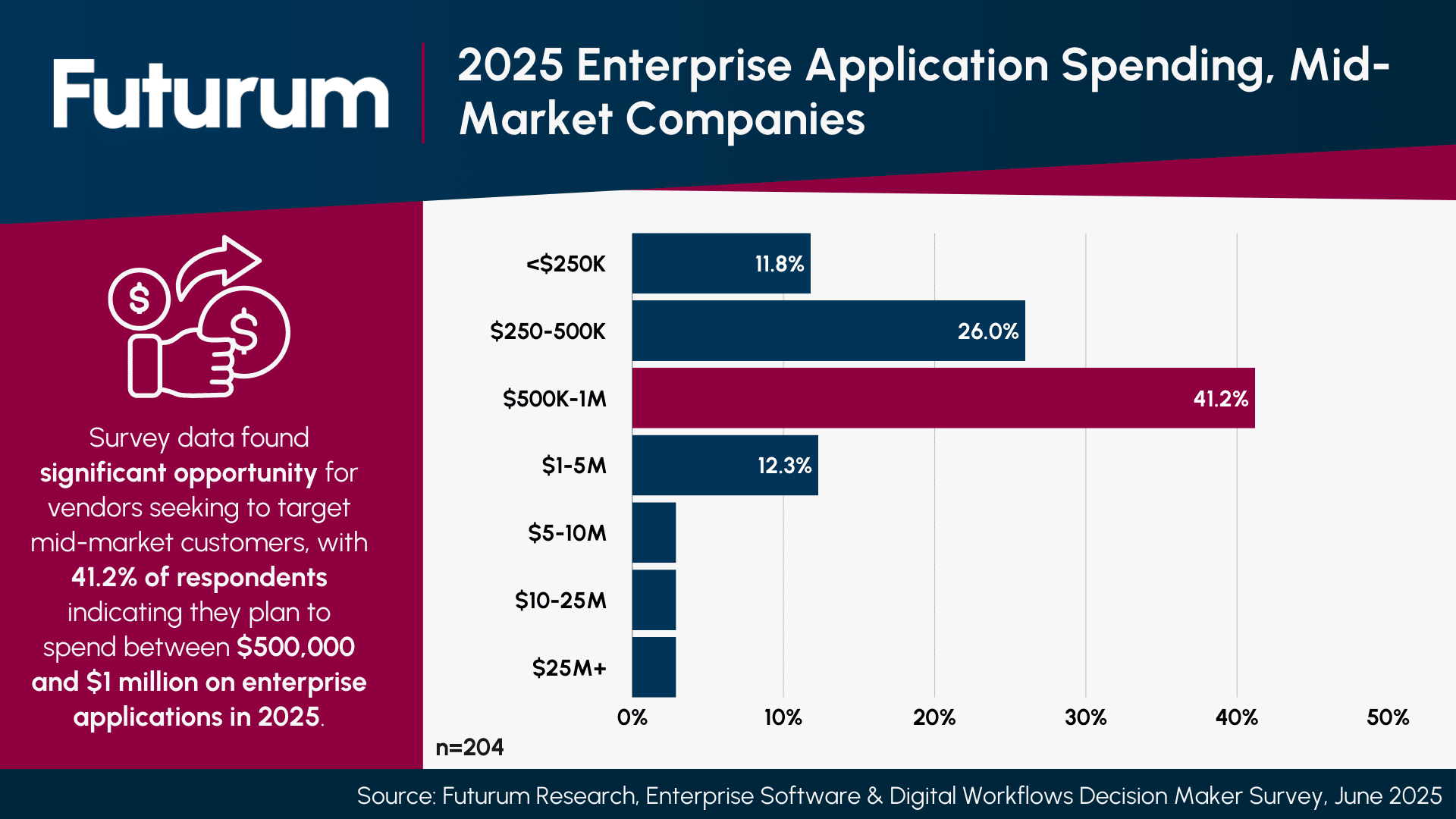
Vendors win fastest by treating the segment as a spectrum – not a single buyer type – and by designing offers that map to typical mid-market constraints: modest internal IT, compressed timelines, and budget bands that concentrate between $250K and $1M annually for application spend.
Product and positioning decisions should follow the buying reality. Futurum Enterprise Applications Decision Maker Survey data published in June 2025 shows broad mid-market adoption across project management, business intelligence, CRM, data management, and digital transformation, categories where buyers are actively allocating spend today, with 41.2% of mid-market respondents indicating they plan to spend between $500K and $1M in 2025.
Figure 1: 2025 Enterprise Application Spending, Mid-Market Companies
Most mid-market teams take a platform-first posture (with point solutions to fill gaps), so modular, composable SKUs work best: an entry tier below $250K, a clear $250K–$1M mid-tier, and an enterprise tier with optional services. That structure enables a land-and-expand motion without alienating smaller buyers.
Go-to-market must prioritize speed-to-value and low implementation risk. Offer fixed-scope, rapid-delivery packages and optional managed services for organizations with limited IT capacity. Leverage resellers and systems integrators on larger deals so customers with heavier integration needs are properly serviced. Emphasize integrations, prebuilt connectors, and templates that shorten evaluations and produce measurable ROI – revenue, cost, or risk reductions – quickly.
Conclusion
Ultimately, commercial models should balance predictable recurring revenue with modern consumption- and outcome-based options to meet diverse procurement preferences. Cross-sell and renewal motions can capture secondary priorities (HR, CCaaS, niche LOB apps) while primary focus rests on BI, PM, CRM, and digital transformation.
Vendors should productize what can be standardized, price transparently, and prove rapid ROI. If executed properly, vendors can turn the mid-market from a neglected opportunity into a repeatable, referenceable growth engine.
The full report is available via subscription to Futurum Intelligence’s Enterprise Software & Digital Workflows IQ service—click here for inquiry and access.
About the Futurum Enterprise Software & Digital Workflows Practice
The Futurum Enterprise Software & Digital Workflows Practice provides actionable, objective insights for market leaders and their teams so they can respond to emerging opportunities and innovate. Public access to our coverage can be seen here. Follow news and updates from the Futurum Practice on LinkedIn and X. Visit the Futurum Newsroom for more information and insights.
Published by Futurum.
More from Keith Kirkpatrick
Adobe’s CEO Succession Bets on Agentic AI and CX Dominance
Keith Kirkpatrick, Vice President & Research Director at Futurum, analyzes how Adobe’s CEO succession positions the company to capitalize on surging enterprise demand for agentic AI and customer experience orchestration.
Salesforce Bundles AI, Slack, and Tableau Into Three New Edition Tiers
Keith Kirkpatrick, VP and Research Director at Futurum, shares his insights on new Agentforce Edition tiers, and discusses how consolidation of AI, Slack, Tableau Next, data security, and Premier Success Plans into a single SKU may help buyers.
The Platform Payoff: How AI Makes the Case for a Unified Enterprise Stack
In our latest thought leadership brief, The Platform Payoff: How AI Makes the Case for a Unified Enterprise Stack , completed in partnership with Salesforce, Futurum Research examines why enterprise buyers are consolidating fragmented AI tools into unified platforms, and what that shift means for…