
Fernando Montenegro, VP and Practice Lead at Futurum, shares his insights on the SASE market. SASE is now a mainstream platform, with buyers open to new vendors and use cases expanding to the intelligent edge and AI security.
Futurum's Fernando Montenegro,
Cite this
Fernando Montenegro, The Futurum Group, "How Does SASE Evolve in the Age of AI? – Report Summary," August 26, 2025. https://preview.erikbethke.com/press-release/how-does-sase-evolve-in-the-age-of-ai-report-summary/

Analyst(s): Fernando Montenegro
Publication Date: August 26, 2025
This report analyzes the evolution of the Secure Access Service Edge (SASE) market as it becomes a more strategic component of enterprise security. Futurum examines how trends such as AI, the intelligent edge, and intense market competition are reshaping SASE architectures and vendor strategies. The analysis reveals a market that, while mature, is experiencing significant flux in procurement strategies and architectural preferences.
Key Points:
- While the SASE market is now mainstream and consolidating around single-vendor platforms, a majority of buyers are open to sourcing from new vendors, creating a dynamic landscape with varied architectural approaches.
- SASE’s value is expanding beyond securing remote users to become a foundational framework for the entire intelligent edge, addressing the security needs of IoT and OT devices.
- A superior user experience, increasingly managed through AI-driven monitoring and policy automation, has become a critical adoption driver, shifting the conversation from cost savings to performance and operational benefits.
Overview:
Figure 1: Stage of Deployment/Interest in the SASE/SSE Platform
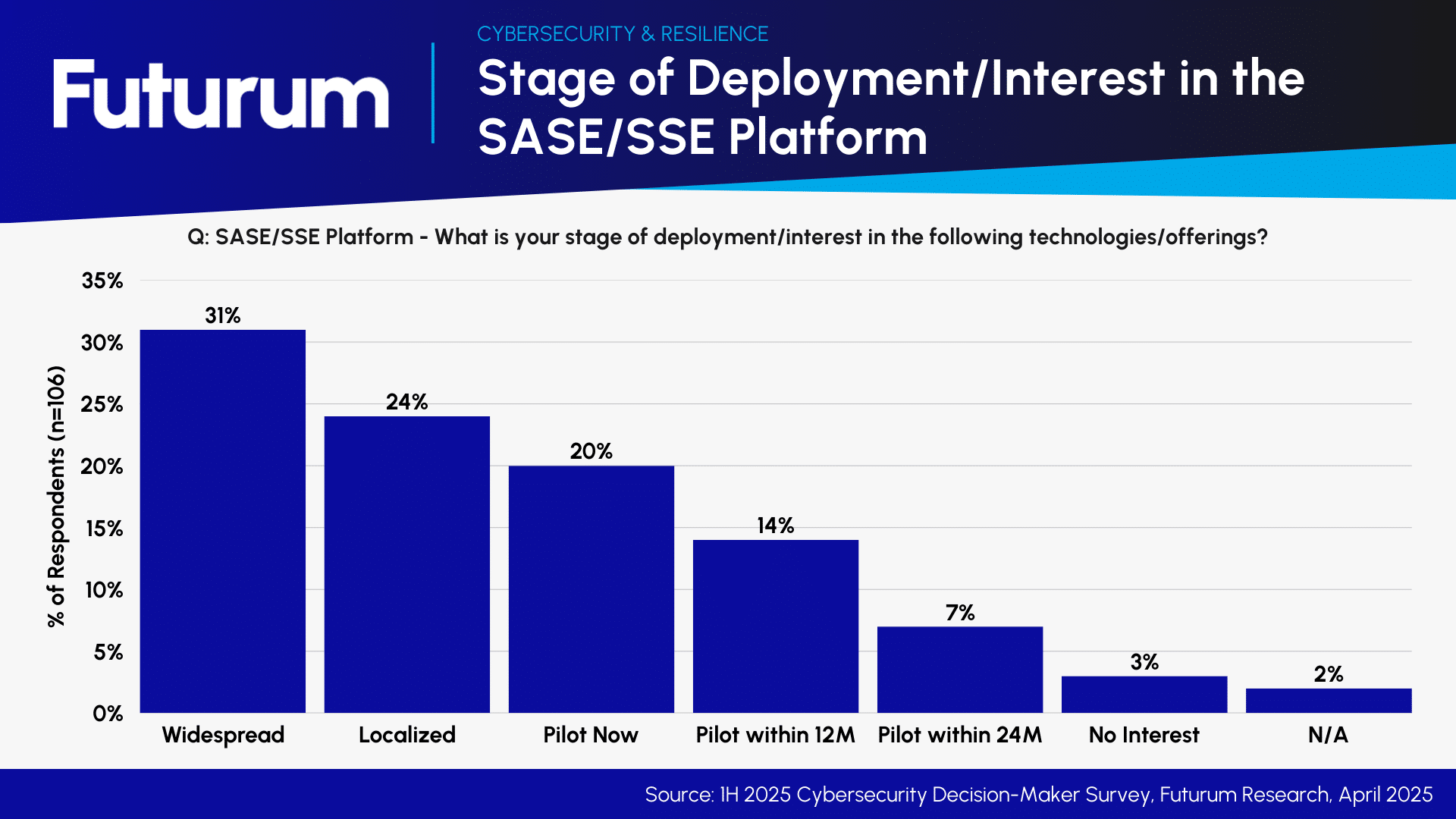
The Secure Access Service Edge (SASE) framework, which converges networking functions such as SD-WAN with a stack of security services into a single, cloud-native offering, has reached mainstream adoption. Its security posture is built on a Zero Trust philosophy, operating on a “never trust, always verify” principle where access is granted to specific applications based on user identity and context, not a trusted internal network. Futurum Group research shows that 55% of respondents across multiple end-user organization types indicated that they have already deployed SASE, with another 41% planning to pilot a platform within two years. While the market trend favors single-vendor platforms to simplify management, a telling finding is that 51% of buyers prefer to source their offering from a new technology vendor rather than an incumbent. This willingness to engage new providers indicates that organizations are actively re-evaluating long-term partners, fostering a dynamic and competitive market where different architectural models can thrive. This diverse landscape includes established network security vendors, cloud-native specialists, and even content delivery network providers leveraging their vast edge infrastructure.
Concurrently, SASE’s scope is expanding dramatically beyond its initial use cases of replacing legacy VPNs and modernizing on-premises web gateways. It is now pivotal for branch modernization, eliminating the need to backhaul traffic to a central data center for security checks. The framework is also being positioned to secure the entire intelligent edge, providing discovery and access control for a massive surface of IoT and OT devices. Furthermore, a critical emerging use case is securing enterprise AI adoption by providing granular control and data loss prevention for interactions with third-party AI services. This evolution means the driver for adoption has also shifted; while reduced complexity and cost are benefits, a superior user and operator experience is paramount. This is delivered through capabilities such as Digital Experience Monitoring (DEM) and, increasingly, AI-driven automation that can proactively remediate issues and assist in creating granular access policies. This strategic importance is validated by intense M&A activity, such as Palo Alto Networks acquiring Talon and Zscaler acquiring Avalor, and major funding rounds for vendors across the ecosystem.
What to Watch:
- How will the need to secure enterprise AI usage, especially regarding data flowing to public models, reshape SASE data security and API inspection capabilities?
- How will the market balance fully converged SASE platforms against more modular, security-first approaches as enterprises evaluate their long-term architectural needs?
- Will major endpoint security vendors enter the SASE market, leveraging their rich device and identity context to challenge network-centric incumbents?
The full report is available via subscription to Futurum Intelligence’s Cybersecurity & Resilience IQ service—click here for inquiry and access.
Futurum clients can read more in the Futurum Intelligence Platform, and non-clients can learn more here: Cybersecurity & Resilience Practice.
About the Futurum Cybersecurity & Resilience Practice
The Futurum Cybersecurity & Resilience Practice provides actionable, objective insights for market leaders and their teams so they can respond to emerging opportunities and innovate. Public access to our coverage can be seen here. Follow news and updates from the Futurum Practice on LinkedIn and X. Visit the Futurum Newsroom for more information and insights.
Declaration of generative AI and AI-assisted technologies in the writing process: This content has been generated with the support of artificial intelligence technologies. Due to the fast pace of content creation and the continuous evolution of data and information, The Futurum Group and its analysts strive to ensure the accuracy and factual integrity of the information presented. However, the opinions and interpretations expressed in this content reflect those of the individual author/analyst. The Futurum Group makes no guarantees regarding the completeness, accuracy, or reliability of any information contained herein. Readers are encouraged to verify facts independently and consult relevant sources for further clarification.
Disclosure: Futurum is a research and advisory firm that engages or has engaged in research, analysis, and advisory services with many technology companies, including those mentioned in this article. The author does not hold any equity positions with any company mentioned in this article.
Analysis and opinions expressed herein are specific to the analyst individually and data and other information that might have been provided for validation, not those of Futurum as a whole.
Read the full Futurum Group Disclosure.
Published by Futurum.
More from Fernando Montenegro
Why AI Learned to Attack Before It Learned to Defend
Fernando Montenegro, VP & Practice Lead at Futurum, shares his insights on how offensive AI succeeds because it’s easier to verify than defensive security, shifting the need for vendors to sell proof of exploitability over volume.
Can Frontier Virtual Patching Close the AI Exposure Gap?
Fernando Montenegro, VP at The Futurum Group, shares insights on how Palo Alto Networks connects AI vulnerability discovery with pre-disclosure network protection.
Brinqa Buys PlexTrac to Put Proof Behind Exposure Management
Fernando Montenegro, VP at Futurum, analyzes Brinqa’s acquisition of PlexTrac and what adding offensive security validation to an exposure management platform does, and does not, prove about remediation.