
Brendan Burke, Research Director at Futurum, analyzes new survey data that enterprise spending on XPUs, a diverse set of AI-specialized accelerators, will outpace GPUs in 2026.
Futurum's Brendan Burke,
Cite this
Brendan Burke, The Futurum Group, "GPU Alternatives Poised to Outgrow GPUs in 2026," January 26, 2026. https://preview.erikbethke.com/press-release/gpu-alternatives-poised-to-outgrow-gpus-in-2026/
Austin, Texas, USA, January 26, 2026
Futurum survey finds that buyers intend to grow spending on XPUs more than on GPUs in 2026.
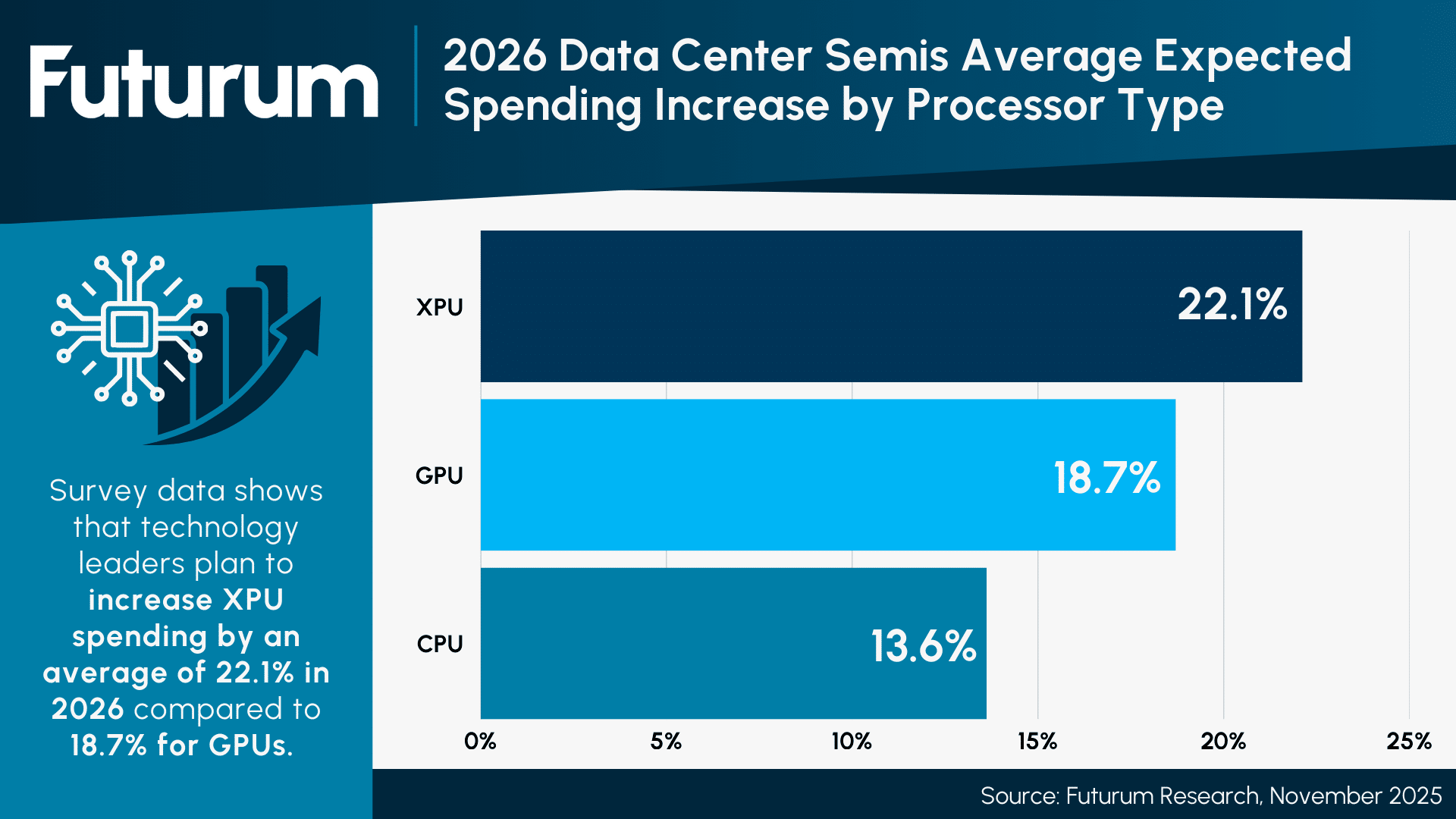
Futurum’s 2H 2025 Data Center Semiconductors Global Enterprise Decision Maker Survey Report shows that technology leaders plan to increase XPU spending by an average of 22.1% in 2026 compared to 18.7% for GPUs.
XPUs refer to specialized accelerators and heterogeneous compute architectures designed to meet the needs of AI-driven workloads.
This trend is especially pronounced among data center operators, who face mounting pressure to deliver low-latency services with consistent pricing. This cohort expects an average of 23.5% XPU spending growth compared to 19.1% for GPUs.
Figure 1: 2026 Data Center Semis Average Expected Spending Increase by Processor Type
Brendan Burke, Research Director at Futurum, said, “Specialized processors help meet the insatiable demand for AI computing while managing economic considerations associated with fast-growing capital expenditures. 2026 will be a breakout year for XPU adoption by AI leaders.”
The survey of 831 global enterprise IT professionals focused on Data Center Semiconductors reveals several key developments shaping the AI software landscape:
- Among XPUs, 31% of decision-makers actively use or evaluate Google TPUs, and 26% do the same for AWS Trainium
- For primary networking fabric, 47% of decision-makers use only Infiniband, and 46% incorporate Ethernet
- 40% of decision-makers primarily deploy AI workloads in the public cloud, and 29% in on-premises data centers
- Only 19% of decision-makers have training-dominant workload mixes, with 38% reporting balanced training and inference, and 33% mainly running inference workloads.
GPUs still lead the market in mindshare, led by NVIDIA (85% using or evaluating) and AMD (46%).
“The results show clear demand for silicon diversification,” noted Burke. “While GPUs have primarily powered the training phase of AI, the inference phase will encourage wider experimentation and coupling of unique workloads with custom designs.”
The survey shows the accelerating growth trajectory of XPUs relative to GPUs. XPU spending growth will outpace GPUs by 2027, according to Futurum’s Data Center Semiconductors Sub-Market Forecast. XPUs can leverage new global foundries and emerging design tools to accelerate time-to-market for new designs. This wave of innovation encourages a portfolio-based approach to semiconductor adoption in the inference phase of AI adoption.
Read more in the “2H 2025 Data Center Semiconductors Global Enterprise Decision Maker Survey Report” and “Q2 2025 Data Center Semiconductor Spot Check Report” on the Futurum Intelligence Platform.
About Futurum Intelligence for Market Leaders
Futurum Intelligence’s Semiconductor, Supply Chain, and Emerging Tech IQ service provides actionable insight from analysts, reports, and interactive visualization datasets, helping leaders drive their organizations through transformation and business growth. Subscribers can log into the platform at https://app.futurumgroup.com/, and non-subscribers can find additional information at Futurum Intelligence.
Follow news and updates from Futurum on X and LinkedIn using #Futurum. Visit the Futurum Newsroom for more information and insights.
Other Insights from Futurum:
Is Tesla’s Multi-Foundry Strategy the Blueprint for Record AI Chip Volumes?
Synopsys and GlobalFoundries Reshape Physical AI Through Processor IP Unbundling
At CES, NVIDIA Rubin and AMD “Helios” Made Memory the Future of AI
Published by Futurum.
More from Brendan Burke
Rapidus’ IIM-1 Fab Construction is Completed. Will Cadence Make It the First Agentic Foundry?
Rapidus’ IIM-1 fab completes construction in Chitose, leveraging Cadence Innostack AI Super Agent for its Raads platform and IBM 2nm transistor IP to compete with TSMC, Intel, and Samsung in inference accelerator production.
SiFive BigSky Ships the First RISC-V Server. Is the GPU Head Node the Prize?
Brendan Burke, Research Director at Futurum, shares his insights on SiFive’s BigSky, the first enterprise-grade RISC-V server, and why CUDA head node duty for NVIDIA GPUs is the socket that matters.
QumulusAI Q2 FY 2026: 118% Revenue Growth for Hyperspeed AI Compute Deployment
Brendan Burke, Research Director at Futurum, analyzes QumulusAI’s Q2 FY 2026 earnings, focusing on direct AI compute demand, GPU fleet expansion, and capacity execution.