Futurum Research: Cybersecurity Sentiment Points to Resilience and Growth

Fernando Montenegro, VP at Futurum, shares insights on new research revealing that while recovery confidence remains steady, organizations are shifting budgets to address the urgent security implications of AI and autonomous agentic systems.
Futurum's Fernando Montenegro,
Cite this
Fernando Montenegro, The Futurum Group, "Futurum Research: Cybersecurity Sentiment Points to Resilience and Growth," January 6, 2026. https://preview.erikbethke.com/press-release/futurum-research-cybersecurity-sentiment-points-to-resilience-and-growth/

Austin, Texas, USA, January 6, 2026
Futurum’s 2H25 Cybersecurity Decision Maker Study Reveals a Prudent Optimism Towards Cyber Resilience
New research from Futurum indicates a period of stabilization for cyber resilience, with nearly two-thirds of organizations expressing confidence in their recovery capabilities and a shift toward increased budget allocations for the coming year.
Findings from the 2H 2025 Cybersecurity Decision-Maker Survey suggest that organizational confidence in responding to and recovering from cybersecurity incidents remains consistent. Currently, 64% of organizations report being either “Very” or “Extremely” confident in their recovery abilities.
Recovery Confidence Supported by Foundational Investments
The study shows a moderate shift in confidence levels between the first and second halves of 2025. The “Extremely confident” segment rose to 23% in 2H25, up from 20% in 1H25. Conversely, the “Very confident” group saw a slight decrease from 44% to 40%.
Figure 1: Confidence in Organizational Ability to Recover from Incident
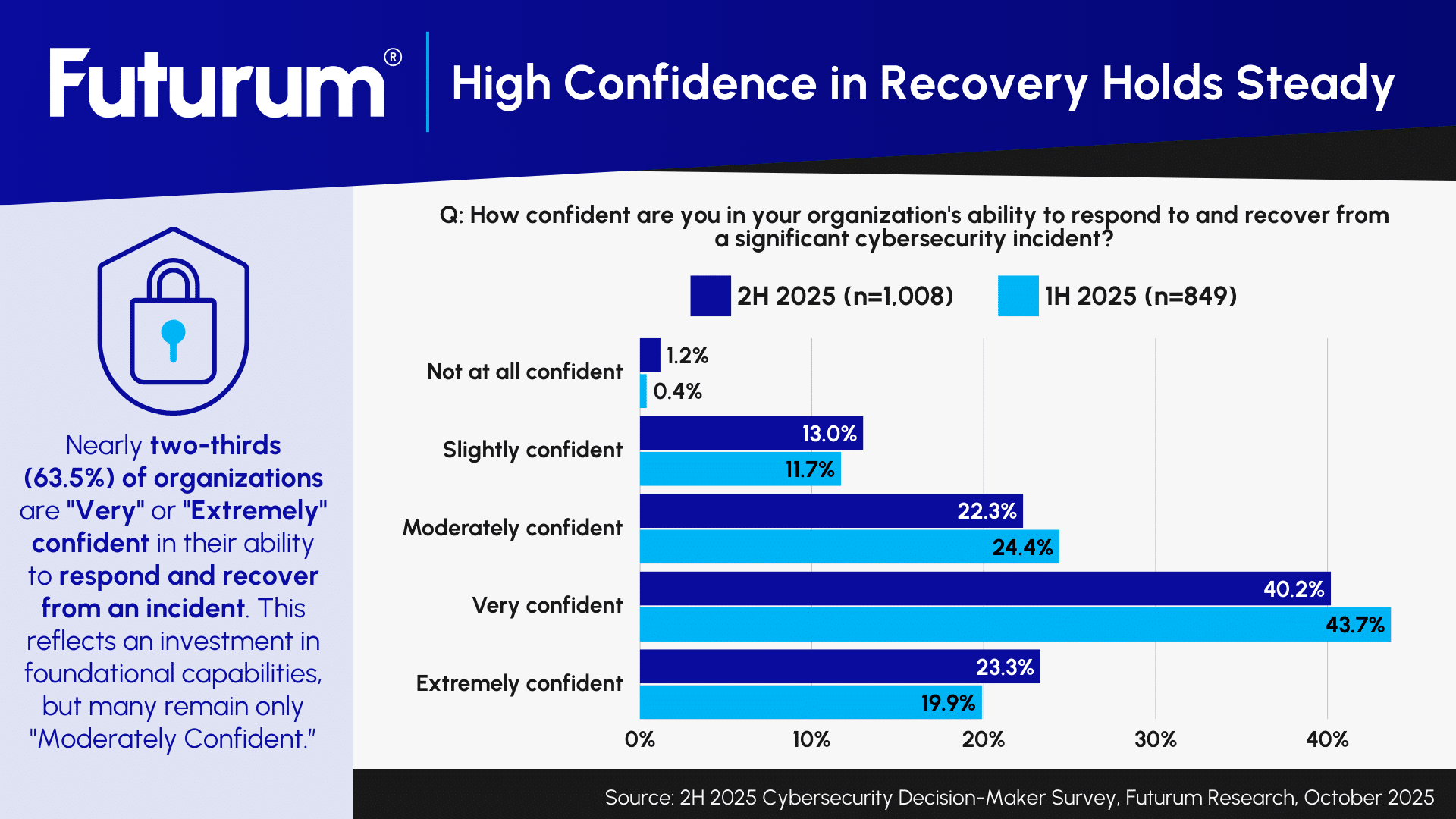
These results reflect ongoing investment in foundational capabilities. However, a portion of the market—22%—remains “Moderately confident,” suggesting that while recovery tools are established, the process of operationalizing them across the enterprise continues to be a focus for many.
“Confidence in the current environment is increasingly tied to the practical ability to recover from an incident with minimal business disruption,” said Fernando Montenegro, VP and Practice Lead at Futurum. “While we see more organizations moving into the higher tiers of confidence, a gap remains for the one-in-five organizations that are still maturing their response strategies.”
Cybersecurity Budgets: A Positive Trend Amid External Variables
The financial outlook for cybersecurity remains positive, although broader external economic conditions inevitably influence spending patterns. According to 2H25 data, 65% of organizations expect a budget increase over the next 12 months.
Figure 2: Expectations around Cybersecurity Budget Changes
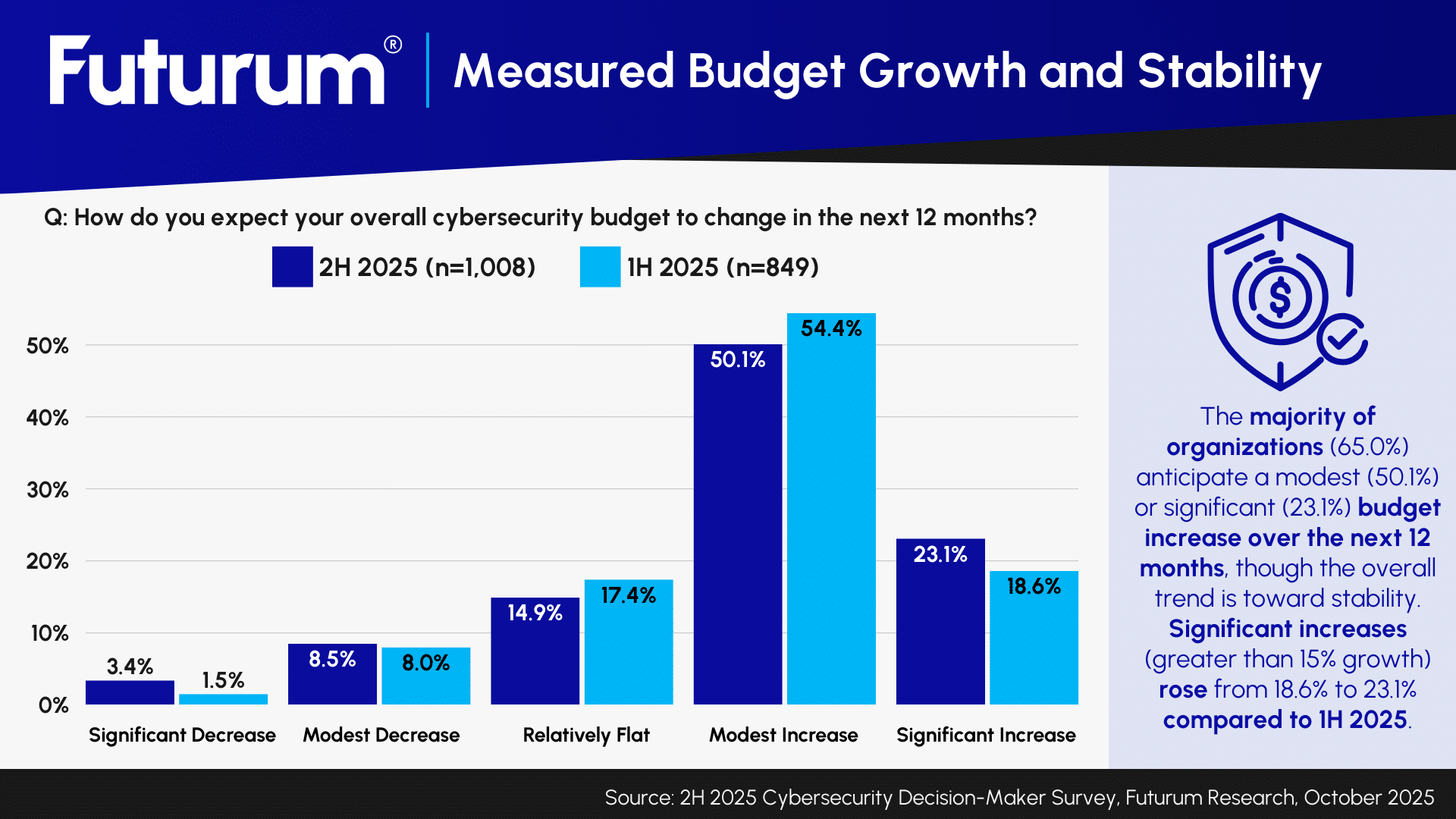
While a “Modest Increase” remains the most common expectation at 50%, there is a noted rise in organizations planning more substantial investments. Those expecting a “Significant Increase” (defined as growth greater than 15%) rose from 19% in 1H25 to 23% in 2H25.
The Urgency of Agentic AI Security
Beyond budgetary shifts, the study highlights a growing concern regarding the security implications of AI initiatives. Organizations are increasingly concerned with the risks introduced by agentic AI, where autonomous systems perform tasks with minimal human intervention.
“The move from flat budgets to more active growth categories indicates that security is increasingly viewed as a standard requirement for digital business operations,” Montenegro added. “However, these budgets are increasingly being asked to support not only ongoing operations, but also to address new frontiers, particularly the deployment of agentic AI. As these autonomous systems become more integrated into workflows, securing their decision-making processes and preventing unauthorized actions has become a priority for security leadership.”
Subscribers can read more in the “2H 2025 Cybersecurity Decision-Maker Survey Report” on the Futurum Intelligence Platform. Non-subscribers can click here for more information.
About Futurum Intelligence for Market Leaders
Futurum Intelligence’s Cybersecurity and Resilience IQ service provides actionable insight from analysts, reports, and interactive visualization datasets, helping leaders drive their organizations through transformation and business growth. Subscribers can log into the platform at https://app.futurumgroup.com/, and non-subscribers can find additional information here.
Follow news and updates from Futurum on X and LinkedIn using #Futurum. Visit the Futurum Newsroom for more information and insights.
Other Insights from Futurum:
Futurum Intelligence Cybersecurity & Resilience IQ
Published by Futurum.
More from Fernando Montenegro
Why AI Learned to Attack Before It Learned to Defend
Fernando Montenegro, VP & Practice Lead at Futurum, shares his insights on how offensive AI succeeds because it’s easier to verify than defensive security, shifting the need for vendors to sell proof of exploitability over volume.
Can Frontier Virtual Patching Close the AI Exposure Gap?
Fernando Montenegro, VP at The Futurum Group, shares insights on how Palo Alto Networks connects AI vulnerability discovery with pre-disclosure network protection.
Brinqa Buys PlexTrac to Put Proof Behind Exposure Management
Fernando Montenegro, VP at Futurum, analyzes Brinqa’s acquisition of PlexTrac and what adding offensive security validation to an exposure management platform does, and does not, prove about remediation.