Enterprise AI ROI Shifts as Agentic Priorities Surge

Futurum’s Keith Kirkpatrick reveals enterprise AI ROI measurement is shifting from productivity to P&L impact, while agentic AI surged 31.5% as the fastest-growing technology priority among 830 IT decision makers.
Futurum's Keith Kirkpatrick,
Cite this
Keith Kirkpatrick, The Futurum Group, "Enterprise AI ROI Shifts as Agentic Priorities Surge," February 17, 2026. https://preview.erikbethke.com/press-release/enterprise-ai-roi-shifts-as-agentic-priorities-surge/

Austin, Texas, USA, February 17, 2026
Futurum’s latest Enterprise Software Decision Maker Survey reveals enterprise AI ROI measurement is shifting from productivity to P&L impact, while agentic AI surged 31.5% as the fastest-growing technology priority among 830 IT decision makers.
The Futurum Group today released findings from its “1H 2026 Enterprise Software Decision Maker Survey Report,” a study of 830 global IT decision-makers that reveals a decisive inflection in how enterprises evaluate and procure AI-driven software. The survey documents a structural shift in enterprise AI ROI measurement: direct financial impact—combining top-line revenue growth and bottom-line profitability—nearly doubled to 21.7% of primary responses. At the same time, productivity gains collapsed 5.8 percentage points as the leading success metric. Simultaneously, Autonomous Agents and Agentic AI surged 31.5% year-over-year as a top technology priority, signaling that the pilot phase of enterprise AI is over.
The data paints a clear picture of an enterprise buyer that has matured rapidly. Productivity gains, the default justification for GenAI investments throughout 2024 and 2025, fell from 23.8% to 18.0% as the #1 ROI metric. In its place, CFOs are demanding hard P&L accountability. The survey split the prior “overall financial performance” metric into two distinct measures—top-line revenue growth (10.6%) and bottom-line profitability (11.1%)—and together these hard financial metrics now dominate the value conversation. Efficiency improvements, while still widely cited at 19.2%, also declined, and customer experience metrics dropped sharply from 11.1% to 8.2%, further confirming the pivot toward financial outcomes over experiential ones.
Figure 1: ROI Measurement Priorities: The Hard ROI Pivot
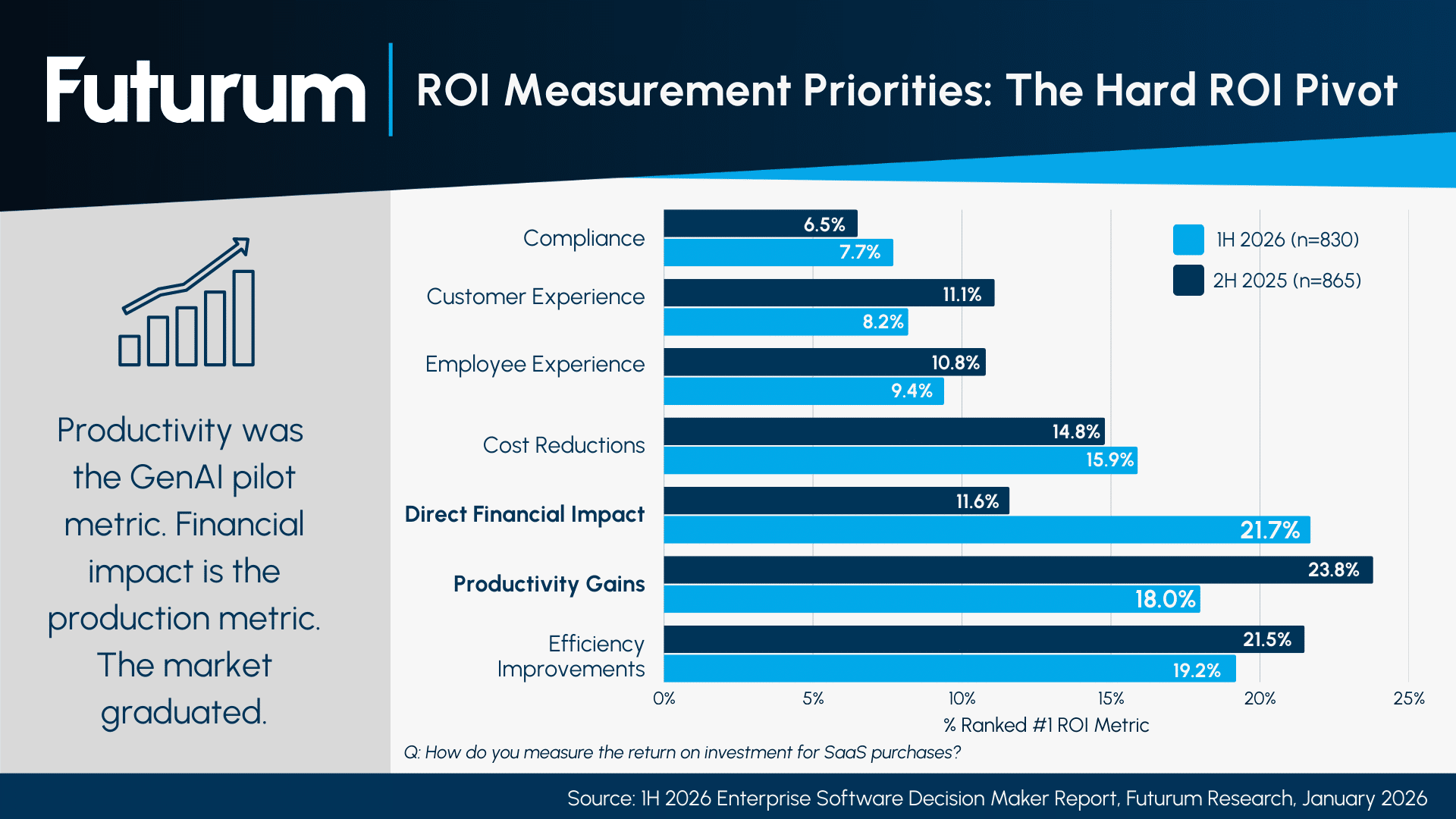
“The 2026 buyer is significantly more sophisticated than their 2025 counterpart,” said Keith Kirkpatrick, Vice President and Research Director at The Futurum Group. “The productivity argument was the right metric for the GenAI pilot phase, but the market has matured. Enterprises are now demanding that every AI capability connect directly to revenue growth or margin improvement. Sales teams leading with ‘save 4 hours per week’ are entering a losing conversation. The winners will be vendors who can demonstrate measurable enterprise AI ROI tied to the P&L—and who can deliver autonomous agents that execute against those outcomes independently.”
Our research also highlights several key developments:
- The Agentic Shift: Autonomous Agents/Agentic AI claimed the #1 technology priority for 17.1% of decision-makers, up from 13.0% in 2H 2025—a 31.5% year-over-year increase and the fastest-growing category in the survey. Combined top-two priority rankings reached 39.3%, up from 32.0%.
- The Death of Best-of-Breed: Best-of-breed procurement fell 3.6 percentage points to 20.7% as enterprises consolidate onto integrated platforms (65.9%, up from 60.0%) to create the unified data fabric that AI demands. 41.0% of organizations are actively planning to reduce their application count.
- The Two-Speed Pricing Strategy: A pricing bifurcation has emerged—consumption-based pricing dropped 5.8 points for core software (to 30.1%) as buyers seek predictability, but surged 5.3 points for GenAI features (to 42.9%) as they reject flat-fee “AI taxes” in favor of usage-based metering.
- The Builder Culture Persists: 56.0% of decision-makers still prefer to build most applications in-house, virtually unchanged from 2H 2025, suggesting that AI-assisted development tools are reinforcing—not eroding—the build preference. A vendor’s biggest competitor remains the customer’s own engineering team.
Subscribers can read more in the full report—“1H 2026 Enterprise Software Decision Maker Survey Report”—on the Futurum Intelligence Platform. Non-subscribers click here for more information.
About Futurum Intelligence for Market Leaders
Futurum Intelligence’s Enterprise Software & Digital Workflows IQ service provides actionable insight from analysts, reports, and interactive visualization datasets, helping leaders drive their organizations through transformation and business growth.
Subscribers can log into the platform at https://app.futurumgroup.com/, and non-subscribers can find additional information at Futurum Intelligence.
Follow news and updates from Futurum on X and LinkedIn using #Futurum. Visit the Futurum Newsroom for more information and insights.
Other Insights from Futurum:
Systems of Agency: Agentic AI to Drive $762B Enterprise Software Super-Cycle by 2031
Should SaaS Vendors Prioritize AI for Vertical or Horizontal Use Cases?
Will Salesforce’s Cimulate Acquisition Redefine AI-Driven Product Discovery?
Published by Futurum.
More from Keith Kirkpatrick
Adobe’s CEO Succession Bets on Agentic AI and CX Dominance
Keith Kirkpatrick, Vice President & Research Director at Futurum, analyzes how Adobe’s CEO succession positions the company to capitalize on surging enterprise demand for agentic AI and customer experience orchestration.
Salesforce Bundles AI, Slack, and Tableau Into Three New Edition Tiers
Keith Kirkpatrick, VP and Research Director at Futurum, shares his insights on new Agentforce Edition tiers, and discusses how consolidation of AI, Slack, Tableau Next, data security, and Premier Success Plans into a single SKU may help buyers.
The Platform Payoff: How AI Makes the Case for a Unified Enterprise Stack
In our latest thought leadership brief, The Platform Payoff: How AI Makes the Case for a Unified Enterprise Stack , completed in partnership with Salesforce, Futurum Research examines why enterprise buyers are consolidating fragmented AI tools into unified platforms, and what that shift means for…