Chip Supply Is the Greatest Barrier to Scaling AI Compute for 26% of Decision-Makers
Austin, Texas, USA

Brendan Burke, Research Director at Futurum, reveals chip supply and power constraints are the dominant barriers to scaling data center compute, with nearly half of organizations citing these as their biggest challenge.
Futurum's Brendan Burke,
Cite this
Brendan Burke, The Futurum Group, "Chip Supply Is the Greatest Barrier to Scaling AI Compute for 26% of Decision-Makers," April 24, 2026. https://preview.erikbethke.com/press-release/chip-supply-is-the-greatest-barrier-to-scaling-ai-compute-for-26-of-decision-makers/
Austin, Texas, USA, April 24, 2026
Futurum Research finds that nearly half of organizations identify accelerator supply and power availability as their biggest constraints to scaling data center compute, according to a survey of key decision-makers.
GPU supply shortages and power/cooling limitations have emerged as the dominant barriers preventing organizations from scaling their data center compute infrastructure, according to a comprehensive decision-maker survey from The Futurum Group.
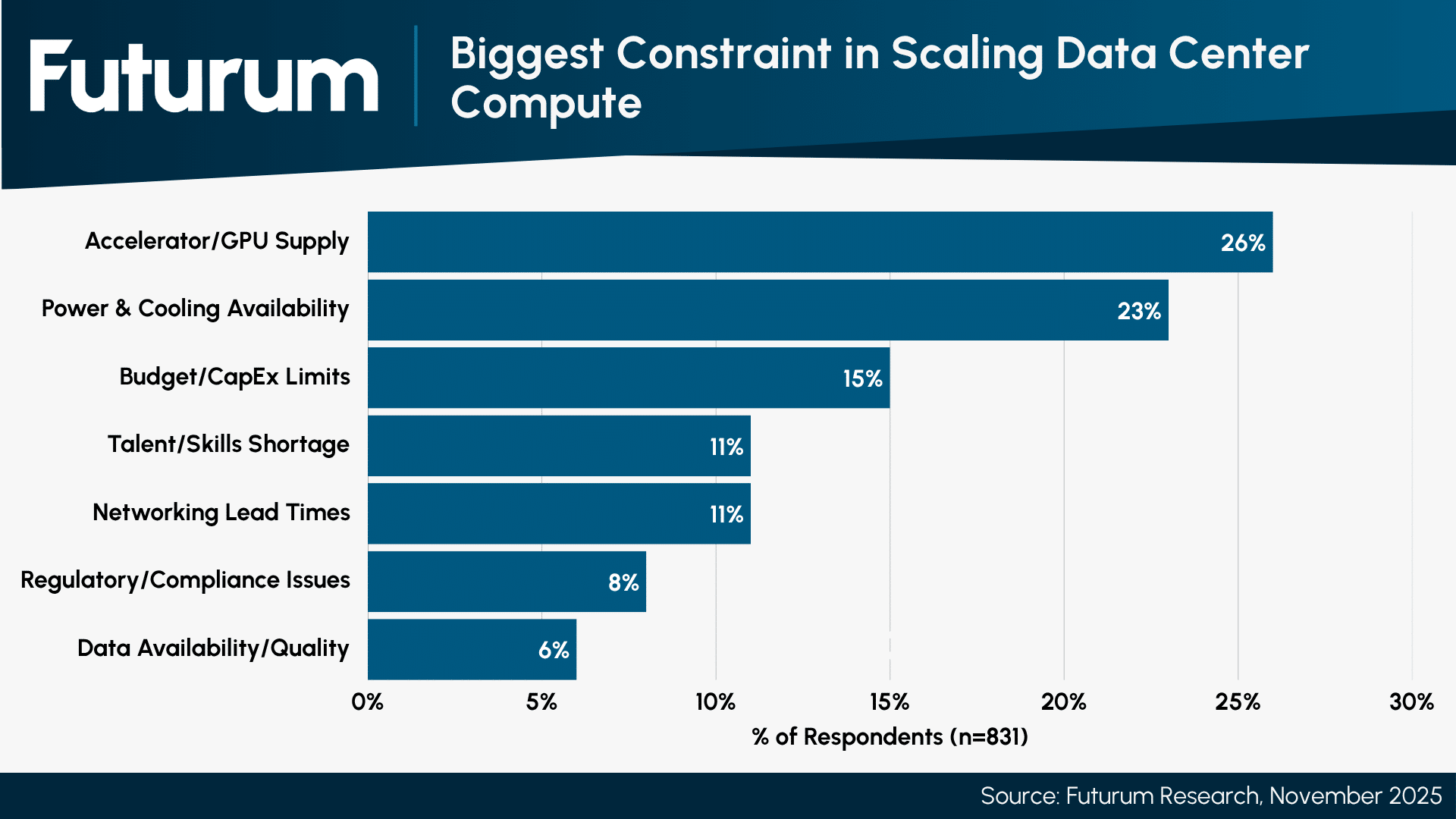
The Futurum Data Center Semiconductors Decision Maker Survey reveals that a combined 49% of organizations cite accelerator/GPU supply (26%) or power & cooling availability (23%) as their single biggest constraint, signaling that AI compute demand continues to vastly outstrip available infrastructure capacity.
Figure 1: Biggest Constraint in Scaling Data Center Compute
Brendan Burke, Research Director, Semiconductors, Supply Chain & Emerging Tech at Futurum, said, “The fact that accelerator supply and power availability together account for nearly half of all scaling constraints tells us that structural realities will define compute investment decisions for years to come.”
The research reveals several key developments shaping the data center semiconductors landscape:
- Chip supply is the single largest bottleneck: 26% of organizations identify accelerator/GPU supply as their top constraint in scaling data center compute, reflecting persistent supply-demand imbalances.
- Power and cooling are a binding ceiling: 23% cite power and cooling availability as their primary constraint — an infrastructure limitation that cannot be resolved with capital alone.
- Budget and talent form a second tier of constraints: Budget/CapEx limits (15%), talent/skills shortage (11%), and networking lead times (11%) collectively affect more than a third of organizations, compounding the supply and power challenges.
- Regulatory and data issues remain a factor: Regulatory/compliance issues (8%) and data availability/quality (6%) round out the constraint landscape, reflecting growing political challenges around permitting and data residency.
“Cloud service providers are driving unprecedented capital expenditure, but even that spending is running into hard physical limits,” noted Burke. “Power generation is a binding ceiling on hyperscaler expansion, and utility infrastructure timelines measure in years, not quarters. This constraint environment means that organizations must adopt a portfolio approach to chip supply and evaluate hybrid deployment models that span public cloud, on-premises data centers, and colocation facilities.”
Read more in the “2H 2025 Data Center Semiconductors Global Enterprise Decision Maker Survey Report” and “Q2 2025 Data Center Semiconductor Spot Check Report” on the Futurum Intelligence Platform.
About Futurum Intelligence for Market Leaders
Futurum Intelligence’s Semiconductor, Supply Chain, and Emerging Tech IQ service provides actionable insight from analysts, reports, and interactive visualization datasets, helping leaders drive their organizations through transformation and business growth. Subscribers can log into the platform at https://app.futurumgroup.com/, and non-subscribers can find additional information at Futurum Intelligence.
Follow news and updates from Futurum on X and LinkedIn using #Futurum. Visit the Futurum Newsroom for more information and insights.
Other Insights from Futurum:
Orbital Computing Can Reach $1 Trillion Addressable Market by 2030 – Subscribers*
State of the Market Report: Semiconductors, Supply Chain, and Emerging Technology, Q2 2026 – Subscribers*
AI Grid Constraints Will Push Over 33% of Data Centers Off-Grid by 2030
Published by Futurum.
More from Brendan Burke
Rapidus’ IIM-1 Fab Construction is Completed. Will Cadence Make It the First Agentic Foundry?
Rapidus’ IIM-1 fab completes construction in Chitose, leveraging Cadence Innostack AI Super Agent for its Raads platform and IBM 2nm transistor IP to compete with TSMC, Intel, and Samsung in inference accelerator production.
SiFive BigSky Ships the First RISC-V Server. Is the GPU Head Node the Prize?
Brendan Burke, Research Director at Futurum, shares his insights on SiFive’s BigSky, the first enterprise-grade RISC-V server, and why CUDA head node duty for NVIDIA GPUs is the socket that matters.
QumulusAI Q2 FY 2026: 118% Revenue Growth for Hyperspeed AI Compute Deployment
Brendan Burke, Research Director at Futurum, analyzes QumulusAI’s Q2 FY 2026 earnings, focusing on direct AI compute demand, GPU fleet expansion, and capacity execution.