Buyers Are Trading Up: 80% More Likely to Buy AI PCs as Traditional PCs Stall at 47%
Austin, Texas, USA

Enterprise buyers are trading up: 80% of IT decision makers are more likely to buy AI PCs than six months ago, versus 47% for traditional PCs, with budgets growing 18.8%, according to Futurum’s 1H 2026 survey of 818 global enterprises.
Futurum's Olivier Blanchard,
Cite this
Olivier Blanchard, The Futurum Group, "Buyers Are Trading Up: 80% More Likely to Buy AI PCs as Traditional PCs Stall at 47%," June 23, 2026. https://preview.erikbethke.com/press-release/buyers-are-trading-up-80-more-likely-to-buy-ai-pcs-as-traditional-pcs-stall-at-47/

Austin, Texas, USA, June 23, 2026
Futurum releases its 1H 2026 Intelligent Devices Global Enterprise Decision-Maker Survey of 818 IT leaders worldwide, highlighting shifting trends in AI PC purchase intent.
The “1H 2026 AI Devices Global Enterprise Decision Maker Survey Report”, a survey of 818 global enterprise IT decision makers fielded in Q2 2026, finds enterprise buyers trading up: 80.4% are more likely to purchase AI PCs for their organizations than they were six months ago, versus 47.1% for traditional PCs. The downside gap is wider still: 19.7% of decision makers are now less likely to buy traditional PCs, against just 1.8% for AI PCs, putting net purchase intent at +78.6 for AI PCs versus +27.4 for traditional PCs. All ten AI PC categories tracked outrank workstations, tablets, and traditional PCs.
Figure 1: Buyers are Trading Up: AI PCs Surge, Traditional PCs Stall
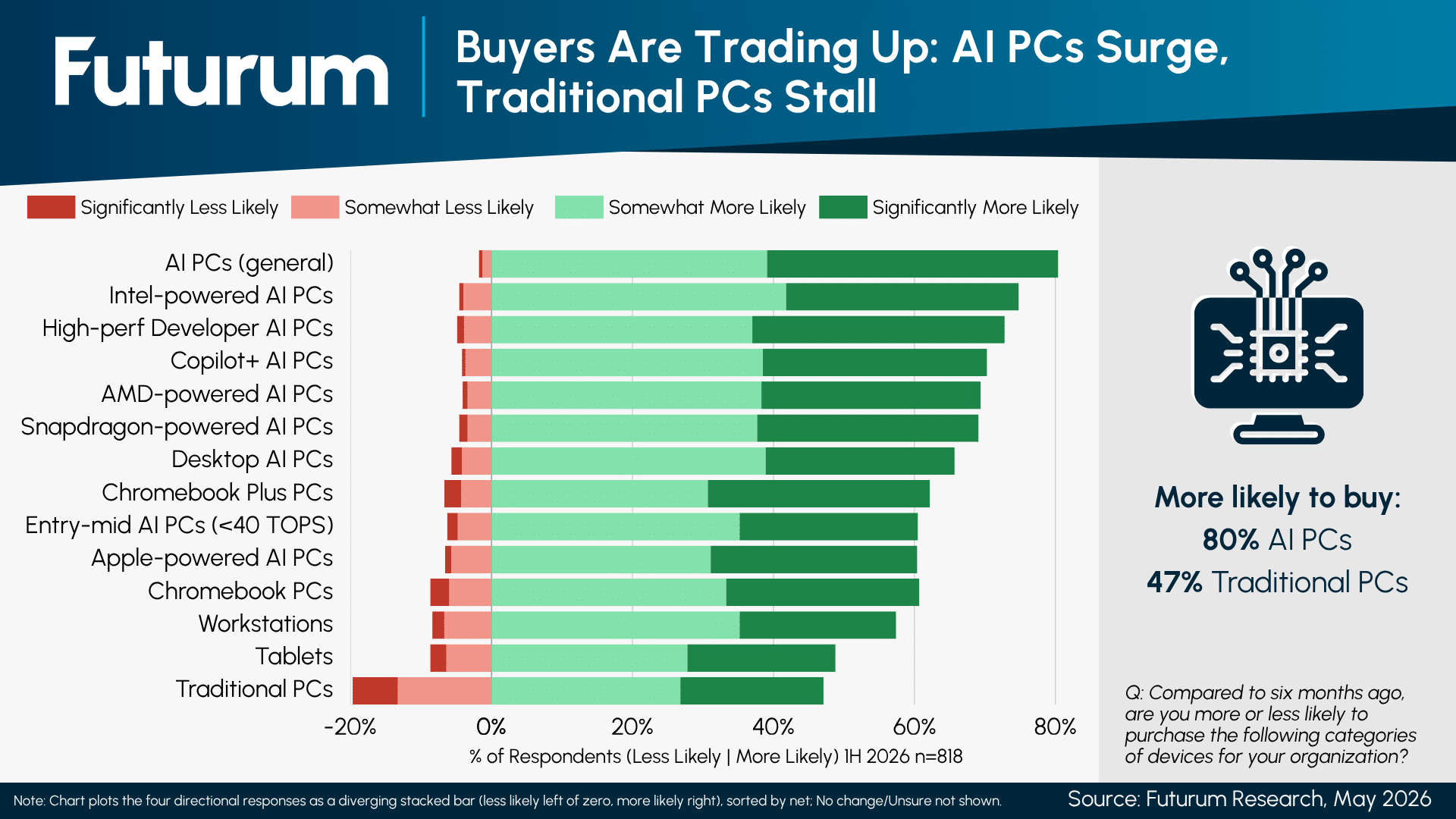
Olivier Blanchard, Research Director & Practice Lead, Intelligent Devices at The Futurum Group, said: “Buyers aren’t just buying into AI-capable PCs; they are clearly moving on from traditional PCs. Four in five decision makers leaning into AI PCs is the strongest signal yet that the refresh cycle has picked a winner. It’s important to understand that this is a trade-up, not a spending spree: budgets are normalizing even as intent concentrates. The best way to frame this new competitive dynamic is that every legacy device in a PC fleet is now competing with an AI PC for the same dollar.”
The 1H 2026 survey reveals several structural shifts in enterprise device strategy:
- Budgets back the trade-up, pragmatically. Organizations expect AI PC spending to grow by a mean of 18.8% in 2026, with 83.9% planning double-digit increases and fewer than 7% planning any cut, even as feature excitement cools 10-15 points versus 2H 2025. Buyers are funding deployment, not hype: 90% still view AI PCs as the next evolution of enterprise computing.
- The processor race is wide open, and Apple is the quiet share-gainer. Intel preference fell to 39% from 43% in 2H 2025, while Apple climbed to 23% from 18%. At the same time, buyer confusion over TOPS ratings and chip architectures rose roughly 4 points, making silicon clarity a real procurement friction.
- The AI PC is a wedge into a broader intelligent device estate. Majorities of organizations are also evaluating AI-capable robotics (56%), smart cameras (52%), smartphones (51%), and smart displays (50%), pulling adjacent device categories into the same refresh conversations.
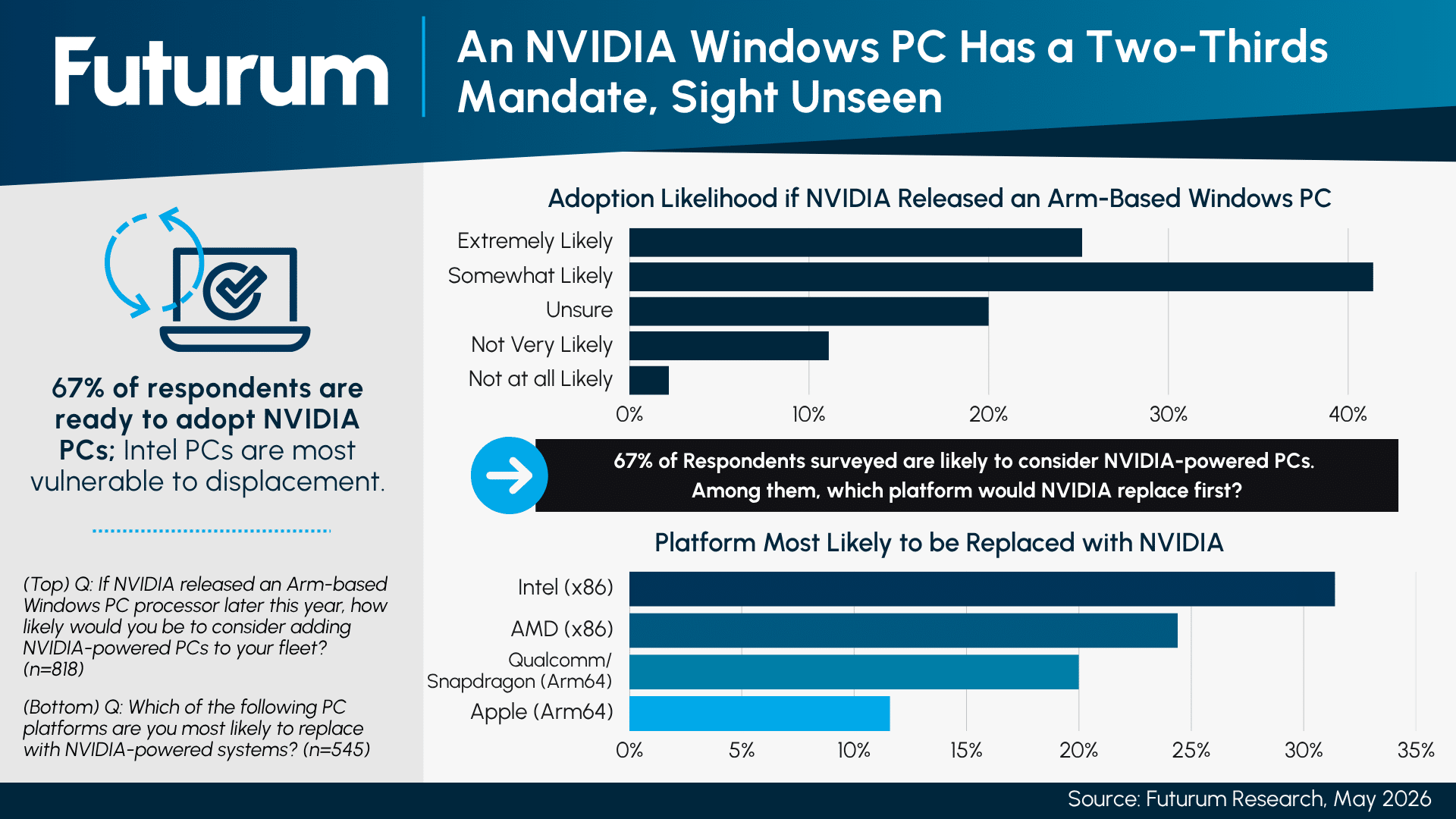
- NVIDIA could enter the PC market with a two-thirds mandate, sight unseen. If NVIDIA shipped an Arm-based Windows PC processor this year, 66.6% of decision makers say they would consider adding NVIDIA-powered PCs to their fleet. Asked what those systems would replace, Intel is the most exposed (31.4%), ahead of AMD (24.4%), Qualcomm (20.0%), and Apple (11.6%).
Figure 2: An NVIDIA Windows PC Has a Two-Thirds Mandate, Sight Unseen
Subscribers can read more in the full report, “1H 2026 AI Devices Global Enterprise Decision Maker Survey Report“, on the Futurum Intelligence Platform. Non-subscribers click here for more information.
About Futurum Intelligence for Market Leaders
Futurum Intelligence’s Intelligent Devices IQ service provides actionable insight from analysts, reports, and interactive visualization datasets, helping leaders drive their organizations through transformation and business growth. Subscribers can log into the platform at https://app.futurumgroup.com/, and non-subscribers can find additional information at Futurum Intelligence.
Follow news and updates from Futurum on X and LinkedIn using #Futurum. Visit the Futurum Newsroom for more information and insights.
Other Insights From Futurum:
Does FOXTRON’s Adoption of Dimensity AX C-X1 Validate MediaTek’s Automotive Ambitions?
MediaTek’s Maturing Edge-to-Cloud AI Strategy Expands Beyond Smartphones
Can Google and Samsung Displace Meta in the Smart Glasses Segment?
Published by Futurum.
More from Olivier Blanchard
Can NXP MCX A5 MCUs Secure the Industrial Edge Before Agentic Attackers Arrive?
Brendan Burke and Olivier Blanchard, Research Directors at Futurum, share their insights on why NXP’s MCX A5, the first MCU to combine a 10BASE-T1S digital PHY, topology discovery, and post-quantum cryptography, gives industrial defenders a head start on agentic attacks.
Can Google’s Pixel 11 Series Redefine the Smartphone Experience?
Google’s Pixel 11 series features the Tensor G6 chip, delivering advanced AI and enhanced photography. Starting at $899, these devices redefine smartphones through personalized AI and superior camera performance.
ASUS Q2 FY 2026 Earnings Hit Record Revenue on AI Servers
Olivier Blanchard, Research Director & Practice Lead, Intelligent Devices with Futurum, analyzes ASUS Q2 FY 2026 earnings, focusing on AI server revenue doubling, and how agentic AI compute positions the company for a multi-year AI cycle.